How to qualify a UK company before the first sales call
A way to qualify a UK company in about a minute, using a single report from Companies House data. Read the score, scan four signals, and decide which prospects are worth your time before you pick up the phone.
Every sales team has similar problems; there are more prospects than there is time, and the ones that look promising on the surface are not always the ones worth pursuing. A company can have a polished website and a confident pitch and still be the wrong company to spend a week chasing, because it can’t afford what you sell, or it’s heading for trouble. The information that would tell you all of this is in public filings at Companies House, but reading raw filings before every call is not realistic when you have a list of two hundred names to work through.
This is a way of qualifying a UK company in about a minute, using a single report, so that you spend your time on the prospects most likely to turn into paying customers and steer clear of the ones that will cost you more than they return.
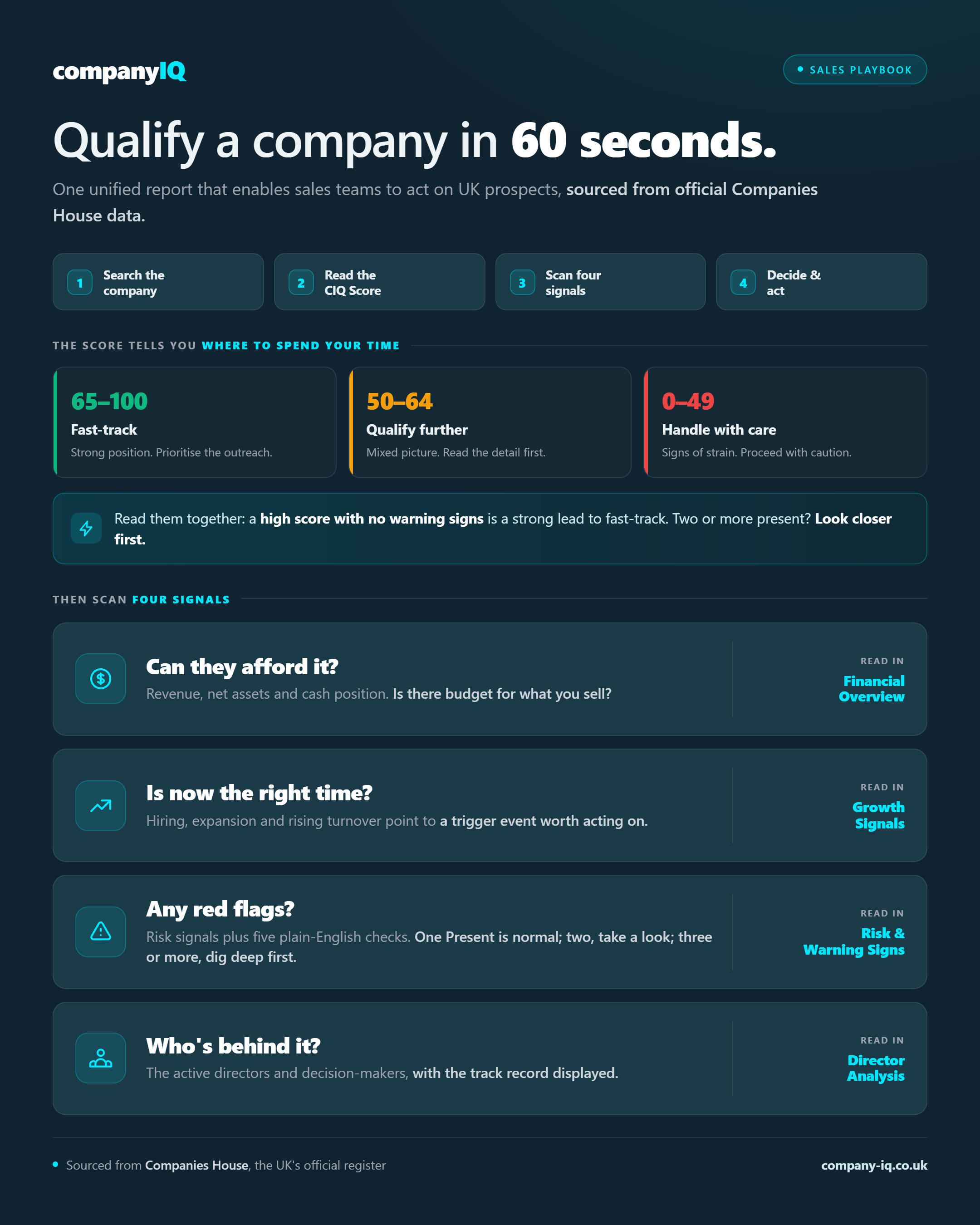
Start with the score, but treat it as a sorting tool
The CIQ Score runs from 0 to 100 and gives you one number for the overall health of a company, which is the fastest possible way to triage a list. It maps onto five grades.
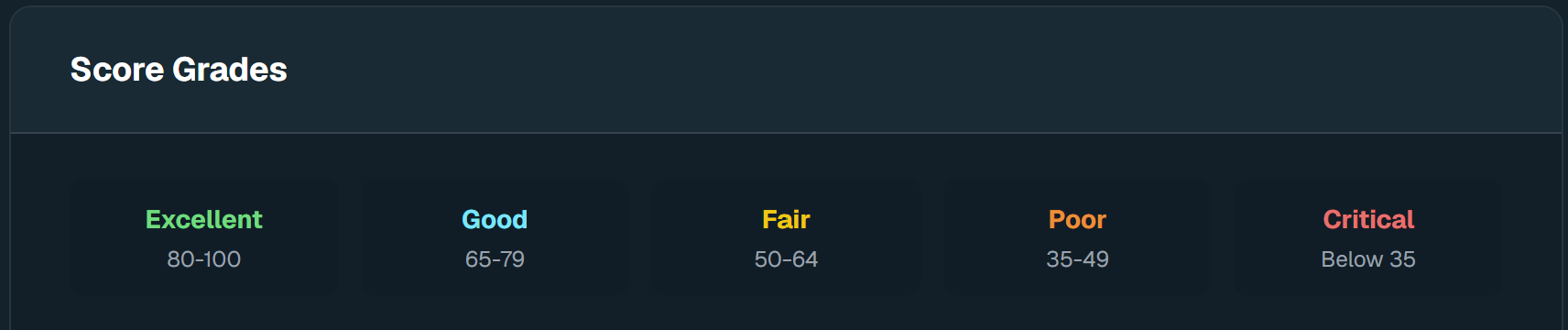
For the purpose of deciding where to spend your time, though, you do not need to hold all five in your head. It is easier to think in three groups.
A company scoring roughly sixty-five or above is in a strong position, and these are the leads to fast-track and prioritise. A company in the fifties or low sixties is a mixed picture, worth pursuing but worth reading the detail before you commit real effort. Anything below fifty is showing signs of strain, and while that does not always mean walk away, it does mean proceed with care and understand what you are dealing with first. The score is not the decision; it is how you decide which prospects deserve the next four minutes of your attention.
Then read four things, each answering a sales question
Once the score has told you a company is worth a closer look, the report answers four questions that matter directly to whether a deal is worth chasing, and each one lives in a specific section.
The first is whether they can afford what you sell. The financial overview shows revenue where it is filed, net assets, and the cash position, which together tell you whether there is a budget for what you are offering. There is little point in pitching a service to a company with no money to spend on it, and this is where you find that out before you have invested a single call.
The second is whether now is the right time. Growth signals, things like hiring, expansion, and rising turnover, point to a company in a phase where it is actively spending and open to new suppliers. A business that is growing is a business with problems to solve and a budget to solve them, and catching one at that moment is worth far more than catching a static company cold.
The third is whether there are any red flags. This is where the risk signals and the five plain-English warning-sign checks come in, and the way to read them is by how many are present rather than treating any single one as fatal. One warning sign present is normal, and plenty of sound companies show one. Two is worth a closer look. Three or more present at once is the pattern that should make you dig deeper before you commit, because, as a study of real company failures showed, it was rarely a single bad number that marked a company heading for trouble; it was several arriving together.
The fourth is who is behind it. The director analysis shows the active directors and decision-makers along with their track record, which tells you both who you will ultimately need to convince and whether the leadership has the kind of history that should give you pause. Knowing the name of the person who actually signs things off, before you make the call, is worth more than most sales intelligence you can buy.
Read the score and the signals together
The score and the warning signs are most useful read as a pair rather than in isolation. A high score with no warning signs present is about as strong a lead as you will find, and belongs straight on the fast track. A high score with two or more warning signs present is the case that warrants a closer look, because the headline number looks fine while something underneath is pulling in the other direction, and that tension is exactly what a single score on its own would hide from you. Reading them together is what turns a number into a judgment.
Then decide, and act
Sign up for a free UK company analysis
Qualify your first prospect in about a minute. No card required.
The whole point of qualifying this way is speed without guesswork. In about a minute, you have moved from a name on a list to a clear sense of whether a company can afford you, whether the timing is right, whether anything should worry you, and who you will be dealing with. That is enough to decide whether this prospect goes to the top of your call list, the bottom, or somewhere in between, and to walk into the call already knowing more about the company than most of your competitors will bother to learn.
CompanyIQ produces all of this as a single report from official Companies House data, and most analyses complete in 60 to 90 seconds. You can see exactly what each part of the report covers on the How It Works page, or run your first company at company-iq.co.uk.
Sign up for a free UK company analysis
CompanyIQ reads the filed accounts and returns a scored report in 60 to 90 seconds.
Run a company checkFirst analysis free, no card required. After that, £15 for a one-off or from £0.50 each on a plan.